(770) 291‑0700 Referral
Endodontic Procedures at Premier Endodontics Alpharetta

At Premier Endodontics, we offer a comprehensive range of advanced endodontic procedures. Each procedure is designed to diagnose and treat conditions affecting the dental pulp (nerve) and root structures. Our aim is to alleviate pain, preserve tooth structure and to restore teeth function. Our caring and experienced staff ensures that every patient receives a warm welcome and stays informed about their dental health and procedures at all times.

Mission Statement: Our mission statement is 3 O’s:

Outstanding patient care and service, Outstanding treatment results and Outstanding long-term success.

At Premier Endodontics, we make sure our patients are being treated by the newest and the most advanced technologies and instruments. We use State-of-art Zu-Max high-powered operating microscopes that requires special training and skills. A diagnostic pulp tester, a high-resolution digital x-ray for two-Dimensional imaging and CBCT (cone beam computed tomography) for three-Dimensional imaging that offer an accurate and detailed information about the tooth in question. We also use a high-end flexible rotary instrumentation to treat the most difficult and complex canals along with Ultrasonic vibrating instrumentation to disinfect and clean the infected canals.

Services

We Offer Variety of Dental Services.

First Visit

Your first visit is an evaluation to determine the proper diagnosis and to present the treatment options. Often, treatment can be initiated and completed on the same day as the consultation, however, a complex medical or dental condition may require an evaluation first, a medical clearance from a medical doctor and then a second appointment to provide the necessary treatment.

For the first visit, patient should provide the office with the following information:

  • The referral slip given by the general dentist.
  • A list of the Patient’s medications and possible allergies.
  • A driver License and Dental Insurance information, also, please bring all the completed forms to save time at the office and to ensure a timely appointment


Root Canal Treatment

A root canal is a treatment designed to save your natural tooth when the nerve is inflamed, infected or damaged. Inside each tooth is a soft layer called the pulp, which contains nerves, blood vessels, and connective tissue. When the pulp becomes inflamed or infected, it can lead to pain, swelling, and, if left untreated, to tooth loss. The procedure involves removing the infected or inflamed pulp from inside the tooth, cleaning, shaping and sealing the canals with special materials to prevent reinfection. Root canal treatment is a routine, non-invasive and painless procedure often completed in a single visit using microscopic precision for the best results. While most treatments take about 60–90 minutes, some cases may take longer or require a second visit.

After completing the treatment, your tooth will be sealed with a temporary filling and an appointment with your general dentist is needed for the permanent restoration (filling and crown) to protect and strengthen your tooth.

Signs You Might Need a Root Canal

  • Ongoing tooth pain, especially when chewing or biting
  • Sensitivity to hot or cold that lingers after the temperature changes
  • Swelling or tenderness in your gums
  • Darkening or discoloration of a tooth
  • A chipped or cracked tooth
  • Unexplained pain in your teeth or jaw
  • Pain while lying down
  • Night pain that wakes you up

What to expect after having a Root Canal Treatment:

It is very normal to have a tender or sore tooth after completing a Root Canal Treatment, in some cases gum and Jaw also will feel sore. This feeling is mostly experienced when biting and chewing on the treated tooth, it is recommended to take any Over-The-Counter pain medicine immediately after the procedure before the anesthesia wears off and keep taking it as needed. It is also recommended to use the opposite side for chewing. Tooth usually recover within 2-3 days.


Root Canal Retreatment

At Premier Endodontics, we are proud to say that our root canal treatments have a very high success rate. However, as with any dental or medical procedure, complications can occur despite our best effort. When a tooth with a previous root canal becomes painful or reinfected, retreatment might be necessary to remove the infection and pain and to avoid extraction of the tooth.

The success rate for a Retreatment is usually lower than an initial Root canal treatment however it is always recommended to save your natural teeth when applicable.

A retreatment is basically performing a second root canal treatment on the same tooth, It consists of reopening the tooth to gain access to the canals, removing the existing root canal filling, disinfecting the canals, find and treat any missing or calcified canal and reseal canals once cleaned and properly shaped. This procedure is also performed under Microscope to ensure best results. You need to return to your general dentist after completing the retreatment for permanent restoration.

What to expect after having a Retreatment:

Same as any Root canal treatment, please refer to Root canal treatment section.


Calcified Root Canal Treatment

Calcified Root canal treatment is a challenging treatment that needs an Endodontist with long experience to address. Calcified teeth are the teeth where the canals have narrowed or hardened over time which makes the canals difficult to locate, visualize and to treat. These blocked canals require high experience, advanced tools and techniques to be treated successfully.

At Premier endodontics, in addition of having a long experience with calcified teeth, we use a Computed tomography CT to help us design a map for the location of the calcified canal, along with the help of high magnification microscope for better outcome

Causes of calcification:

There are multiple reasons why a canal might get calcified, trauma to a tooth, tooth disease such as a longstanding cavity (tooth decay). Aging also is a main cause behind the calcium deposit in a canal. Calcification is asymptomatic, patient would not have any sign or symptoms other than a subtle change in the color of the tooth.


Apicoectomy (surgical Root Canal Treatment)

When initial Root canal treatment and retreatment fail and infection persisted or reoccur, surgical Root canal treatment would be the last resort before extraction.

Apicoectomy is a common procedure in Endodontic offices, it provides a direct access, through an incision, to the infection site where the endodontist will remove the infected soft tissues located usually around the tip of the root and treat the tip of the root accordingly.


This procedure is performed in our office under local anesthesia similar to any other dental procedure. However, recovery time is longer and patient may experience swelling, bruising and some pain afterward. Therefore, a medical prescription might be given to the patient after the surgery if needed.


Apicoectomy alternatives:

Often, the only alternative to surgery is extraction of the tooth. The extracted tooth must then be replaced with an implant, bridge, or removable partial denture to restore chewing function and to prevent adjacent teeth from shifting. No matter how effective modern artificial tooth replacements are, nothing is as good as your natural tooth


Traumatic tooth Injuries

Traumatic tooth injuries can occur in many different situations such as contact sports, car accidents, fall or fights or even everyday activities such as chewing hard substance like ice or griding and clenching teeth. All the previous situation can result in tooth trauma or even teeth being knocked out. An emergency treatment is required to repair or reposition the tooth in case of displacement and to prevent further infection and discomfort.

Treatment and recovery are different depending on the situation, it ranges from a small filling in case of chipped tooth to reposition, stabilization, root canal treatment and monitor in case of complete displacement and dislodgement.


Cracked Teeth

Cracked teeth are a form of dental trauma but it occurs as a result of a longstanding habit such as chewing and biting on hard substances like ice or nuts, clenching and grinding teeth and aging of the tooth due to simple wear and tear

Symptoms are usually a discomfort to biting and chewing, a sharp electric type of pain when biting in a specific way or on a particular spot and increased sensitivity to cold and/or hot. In some severe cases, such as vertical root fracture, we see large bone loss around the root of the tooth and in other cases, patient would have no symptoms whatsoever.

Types of Cracks:

Different types of cracks can be noticed, including:

  • Craze line: which is a superficial crack in the enamel layer, usually do not need any treatment.
  • Fractured cusp: which is usually treated with root canal and a crown or just a crown
  • Split tooth: only can be treated if the split is superficial
  • Vertical root fracture: tooth is completely split in two halves and cannot be saved.


Root Resorption

According to AAE (American association of Endodontics), root resorption is a condition characterized by a physiologic or a pathologic process resulting in the loss of dentine and/ or cementum of the root. Resorption can be considered a normal physiological process in deciduous teeth (baby teeth). However, when permanent teeth undergo root resorption, it is almost always a pathological process.


Root resorption is generally divided into two broad categories which are based on where the identified resorptive process has originated from, either internal resorption or external resorption which is subdivided into a multiple different type.

For a Root Resorption to take place, a change in the protective layer of the tooth/root along with an active ongoing inflammation next to the exposed area.


Causes of root resorption: Multiple reasons can play a role in this process, mainly trauma, bleaching (whitening of the teeth), Orthodontic treatment has also been linked to resorption and many other different reasons.


Treatment of root resorption: Depends on the type, location and size. Some cases may only need a root canal treatment, others may need a root canal treatment and a simple surgical procedure to correct and fill the resorptive defect surgically. Some other invasive cases are not treatable and tooth cannot be saved.


Meet the Doctor

...

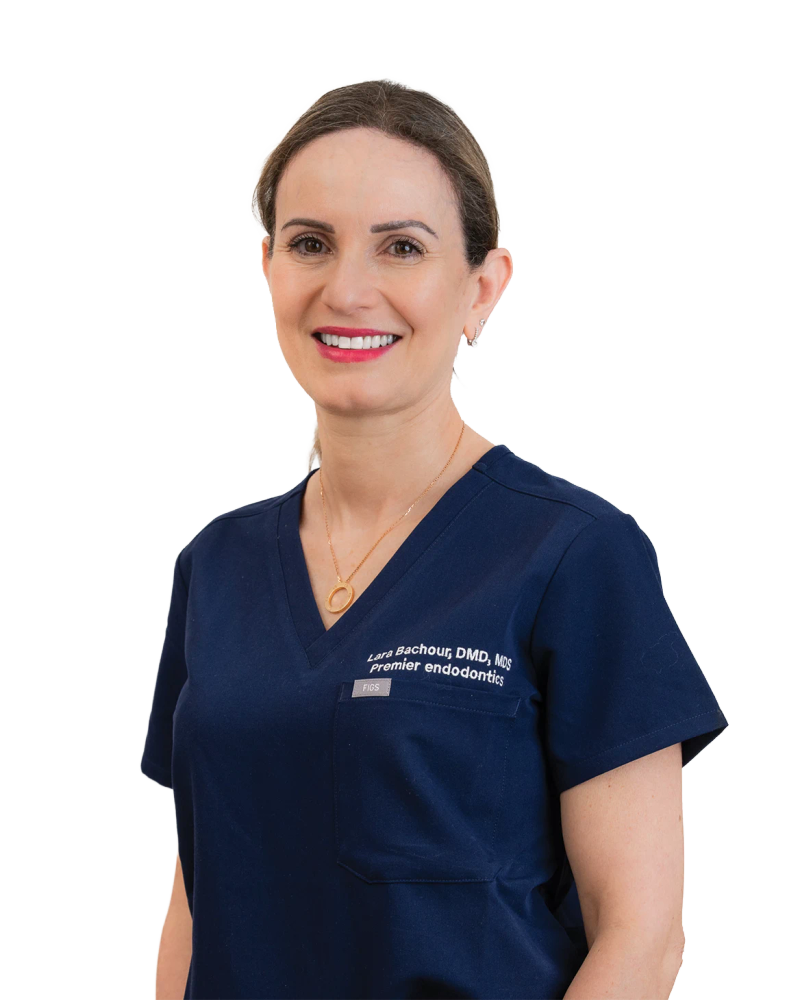
Dr. Lara Bachour

Principal Dentist and Owner

Dr. Lara Bachour has only on passion when it comes to dentistry and that is Endodontics also known as Root Canal Therapy, she has been doing Root canal treatments for over 20 years. Dr. Bachour is a graduate of Rutgers school of Dental Medicine in New Jersey.
She is thrilled and very excited to serve the great state of Georgia in general and Alpharetta area in particular. After moving between multiple state, she finally settled down here after falling in love with the amazing weather, nature and the great people of Georgia.
Dr. Bachour has a very long experience with hundreds of happy and satisfied patients, she is dedicated to providing an outstanding experience and outstanding results for her patients. Dr Bachour lives in Alpharetta and enjoys reading, listening to classic music and traveling. In her free time and during weekend, she enjoys spending quality time with her husband and her two young kids.
She is a member of the American Association of Endodontists (AAE), the Georgia Association of Endodontists (GAE), the American Dental Association (ADA), the Georgia Dental Association (GDA), the Northern District Dental Society (NDDS).
Reviews

See what our patients say about us. You can read more Here

...
Not so painful as I was imagining in my
head
...
This is now my
4th
root canal.
...
Better than expected - and had high
expectations

Modern Endodontics

What is Endodontics and what is modern Endodontics:

Endodontics is a specialty of Dentistry that deals with the inflammation or infection of the dental pulp (nerve) and the surrounding tissues.


Modern Endodontics is also known Micro-dentistry which is a special area of dentistry that uses high-powered operating microscope to get a close-up view of the tooth in question and the surrounding tissues. It has lots of applications in both surgical and non-surgical root canal treatment, helping the dentist treat a wide range of complex procedures with a very high degree of precision which reflects positively on the success rate of any given procedure. It also helps during cavity debridement to ensure that all and only the decayed portion of the tooth is removed, leaving more of the healthy tooth structure to preserve the strength and integrity of the tooth and avoid loss.

Is Micro-dentistry painful?  No, in fact, because it removes less healthy tooth material and offers far greater precision, patients often experience less discomfort when Micro-dentistry techniques are used.

Why Endodontics?

Why you need an Endodontist?

An endodontist is a dentist with two or more years of additional specialty training focused exclusively on diagnosing and treating problems inside the tooth and at the root. While general dentists provide a wide range of services, endodontists:

  • Perform root canals and related surgeries every day
  • Treat complex cases such as calcified canals or root resorption
  • Treat emergency cases referred by other dentists
  • Use specialized equipment, such as dental microscopes, CBCT scans and diagnostic pulp testers, for greater precision and better diagnosis

If you have tooth pain, infection, or an injury affecting the tooth root, an endodontist has the skills and technology to save your tooth when possible.